Electrifying European Industry: EU-Funded Innovations Show the Way Forward
October 30Electrification is becoming increasingly important in Europe’s efforts to decarbonise industry, strengthen energy security and reduce reliance on fossil fuels. With industry accounting for around a quarter of the EU’s energy demand, accelerating the deployment of cleaner technologies for industrial processes represents both a major challenge and an opportunity for European competitiveness.
The European Commission is putting renewed attention on this transition. Its work on the electrification of industry highlights technologies such as industrial heat pumps, electric boilers, heat recovery, energy storage and industrial symbiosis as solutions that can help replace fossil fuels while improving the efficiency and flexibility of industrial energy use.
A new European Commission publication, Industrial Electrification and Energy Efficiency: Technological Success Stories from EU Programmes, provides a closer look at innovative solutions already being developed and demonstrated with EU support. The analysis covers 189 demonstrators from 85 EU-funded projects across 21 Member States, showcasing technologies with the potential to contribute to a cleaner and more competitive European industrial sector.
From the 189 demonstrators reviewed, the Commission highlights 20 success stories across five technology families, selected for their contribution to industrial competitiveness, fossil-fuel reduction and decarbonisation, EU added value and replication potential. The report also notes that many of the technologies assessed have moved beyond the start-up phase and are now reaching scale-up or production, shifting the focus increasingly towards wider industrial deployment.

From innovation to industrial application: the INDHEAP example
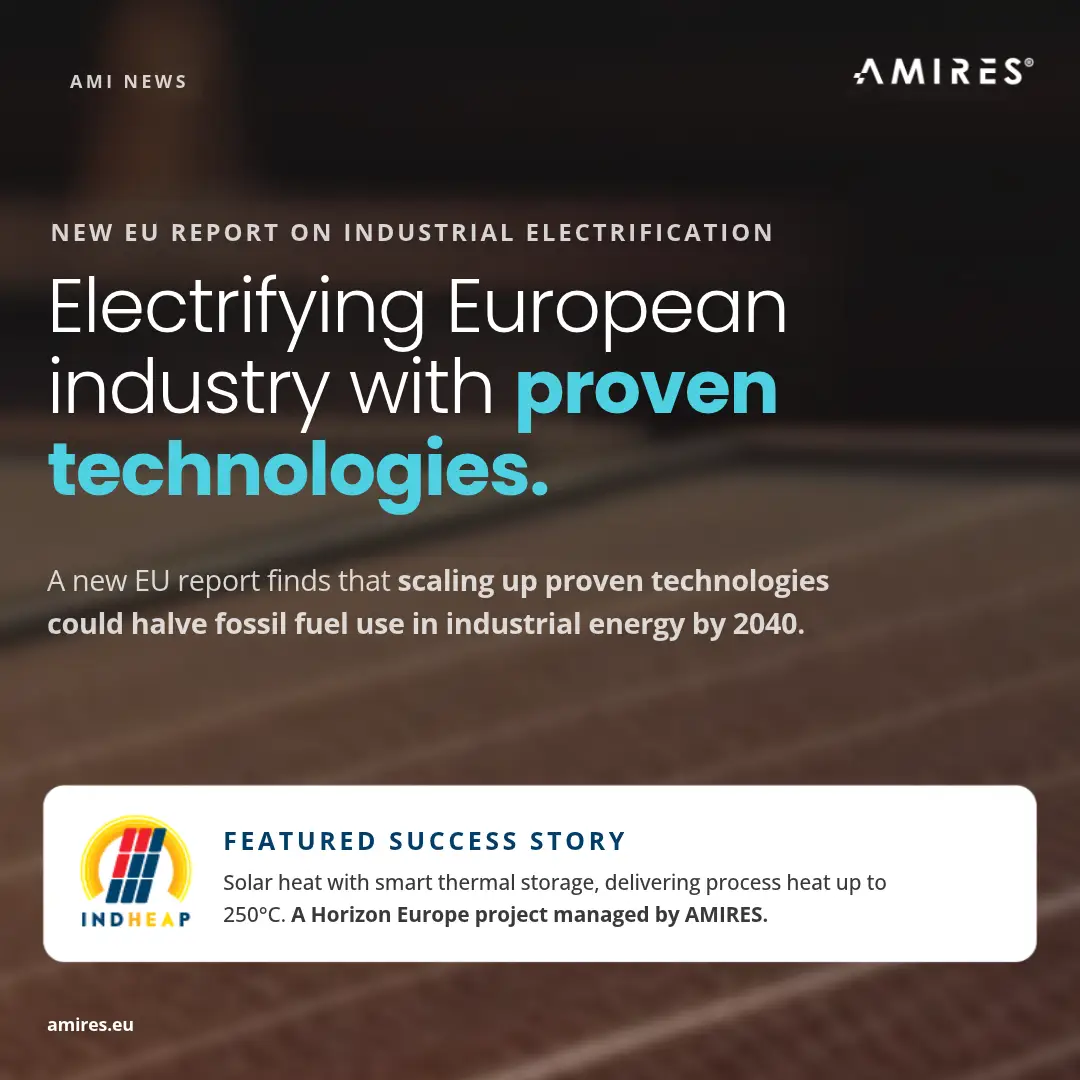
One of the projects highlighted is INDHEAP, which is featured among solutions addressing the flexibility, integration of local renewables and storage. The project has a dedicated success story focusing on its approach to combining solar energy with electric-boosted thermal energy storage for industrial applications.
INDHEAP combines solar thermal collectors and photovoltaic panels with flexible thermal energy storage that can also be charged using electric heaters. This approach enables renewable energy and electricity to be stored and used to provide industrial process heat of up to 250°C when required. The Commission also highlights the solution’s potential to reduce heat and electricity peak demand and contribute to greater flexibility in the energy system.
This reflects a broader shift in industrial energy systems, where flexibility is becoming increasingly valuable alongside decarbonisation. The report points to a progression from first-of-a-kind demonstrations towards site optimisation, industrial clusters and flexibility aggregation. Across this technology family, optimised energy management can typically reduce on-site costs by up to 17–20%, depending on the value of flexibility and revenues from surplus energy production.
Scaling up solutions for a competitive, decarbonised industry
The examples highlighted by the European Commission demonstrate that industrial decarbonisation is not dependent on a single technology. Electrification, renewable energy integration, energy storage, heat recovery and greater flexibility can complement each other in addressing different industrial energy needs.
According to the report, large-scale deployment of the technologies presented could halve the share of fossil fuels in industrial energy demand by 2040.
The scale of the transition ahead is significant. Energy-system modelling presented in the report indicates that electricity could increase from 33% of industrial final energy consumption in 2025 to 49% by 2040. Over the same period, industrial energy efficiency, measured as value added per energy consumed, could improve by 32%, while industrial CO₂ emissions could fall by 65%.
At the same time, significant barriers remain. Electricity costs, grid constraints, investment needs, competitiveness concerns and policy uncertainty can all affect the pace of industrial electrification.
Reaching this potential will therefore depend on more than technological readiness. The Commission identifies factors such as access to grid connections, investment conditions and simpler permitting as important for wider deployment. For flexibility, renewables and storage specifically, access to flexibility markets and closer coordination between industrial production and energy management will also be key.
Projects such as INDHEAP therefore illustrate the role of EU research and innovation funding in moving promising technologies towards industrial application and supporting Europe’s broader energy transition.
AMIRES is part of the INDHEAP consortium, supporting the project through administrative project management and communication and dissemination activities. Find out more: Explore the European Commission’s work on industrial electrification, read the full Industrial Electrification and Energy Efficiency report, and discover the INDHEAP project.