Good Health and Well-being
August 27Sustainable Development Goal 3 (SDG3) focuses on ensuring healthy lives and promoting well-being for people of all ages. It aims to reduce early deaths from diseases through prevention and treatment, support mental health, and ensure that everyone has access to quality healthcare, essential medicines, and vaccines. It also targets the elimination of preventable deaths among mothers, newborns, and children, and the fight against major epidemics.
To help achieve this goal, innovative technologies are playing an increasingly important role in monitoring health and supporting healthier lifestyles. Among these are ultrasound, bioimpedance, and graphene-based biosensors.
How do these technologies work?
- Ultrasound is a safe and non-invasive imaging technique that uses high-frequency sound waves to create real-time images of the body. It allows doctors to see organs, tissues, and blood flow without surgery or radiation.
- Bioimpedance measures how electrical currents pass through the body. Different tissues—such as fat, muscle, and blood—conduct electricity differently. By analyzing this, bioimpedance can provide insights into body composition and overall health.
- Graphene-based biosensors rely on graphene, an ultra-thin material made of a single layer of carbon atoms arranged in a honeycomb structure. Graphene is highly conductive, sensitive, and stable, making it ideal for detecting tiny biological signals. For example, it can identify molecules like glucose or haemoglobin by measuring small changes in electrical signals, enabling fast and accurate health monitoring. For that specific biorreceptors towards targeted MetSyn biomarkers are to be identified and immobilized on graphene surface keeping the extraordinary electrical performance of the GFET.

Figure 1. Schematic illustration of a biofunctionalised graphene field-effect transistor (GFET) sensor and the principle of biomarker detection through changes in the device electrical response.
From research to real-life impact
At AMIRES, these technologies come together in the Horizon Europe project UltraSense. The project is developing a flexible, wearable sensing platform designed to monitor body composition and health in a continuous and non-invasive way. By combining advanced materials, smart sensors, and AI-based data analysis, UltraSense supports more personalised and accessible healthcare, contributing to healthier and more sustainable lifestyles.
Behind UltraSense is a diverse team of researchers advancing health technologies. Today, we highlight four outstanding women whose work contributes to better prevention, monitoring, and treatment of disease:
- Prof. Ioanna Zergioti (National Technical University of Athens-NTUA) – Project Coordinator and a world-leading expert in laser technologies, with over 30 years of experience. Her work in laser printing and bioprinting has helped bridge advanced materials and life sciences, contributing to more than 200 publications and several patents.
- Mrs Maria Anna Chliara ((National Technical University of Athens-NTUA) early- stage researcher at NTUA, with expertise in laser induced forward transfer of advanced materials and characterization of biosensors.
- Dr. Amaia Zurutuza (Graphenea) – Scientific Director with extensive experience in both academia and industry. Her work focuses on graphene-based materials and their applications, including in healthcare. She has led numerous European research projects and contributed to high-impact innovations in advanced materials and controlled drug delivery.
- Dr. Amaia Rebollo (Graphenea) – Scientific Researcher with expertise in biosensors, nanofabrication, and biomaterials. Her work connects material science with biomedical applications, supporting the development of innovative sensing solutions.
- Prof. María José Bañuls Polo (Universitat Politècnica de València – UPV) – Distinguished Researcher at IDM and Full Professor at UPV, specialized in Analytical Chemistry with applications in Biotechnology. Her work focuses on the development of cutting-edge analytical methodologies for DNA and protein biosensing, with applications in environmental, food, and clinical sciences. Among her key research areas are surface biofunctionalization, the synthesis of bioresponsive hydrogels, and their transformation into diffraction-based biosensing platforms for immunoassays and nucleic acid hybridization tests.
- Dr. Tuire Salonurmi (University of Oulu – OULU): She has extensive, multidisciplinary research experience as a postdoctoral researcher, research scientist, and university researcher in the fields of molecular biology and digital health. While her PhD was in biochemistry and molecular biology, her current research focuses on the molecular and cellular mechanisms behind obesity, clinical ICT-based intervention studies, and biosensors. She holds the Title of Docent (Adjunct Professorship) in the biochemistry of metabolic diseases. Currently, she coordinates the health vertical of the 6GESS profiling theme at the University of Oulu, funded by the Research Council of Finland. Under the overarching theme of preventive medicine, her research interests encompass digital health, ICT interventions, health and eating behavior change, metabolic syndrome, obesity, adipose tissue, and cardiovascular diseases.

2. Amaia Rebollo with Graphene Field-Effect Transistors (GFETs)

3. Amaia Zurutuza at Graphenea’s facilities

3. María-José Bañuls at her biosensors lab

4. Ioanna Zergioti and Maria Anna Chliara at NTUA’s lab

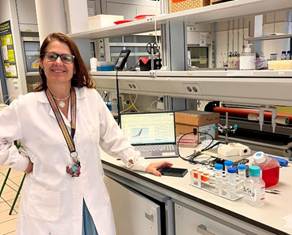
5. Tuire Salonurmi at her lab
These examples represent just a few of the many inspiring women involved in Ultrasense project
Driving impact towards SDG 3
Participating in projects like UltraSense, AMIRES supports the development of technologies that promote well-being and help prevent non-communicable diseases such as obesity and related conditions.
By highlighting the contributions of women in research, we also reinforce an essential message: inclusive excellence is key to advancing science and achieving SDG 3—ensuring good health and well-being for all.